




NASA’s aircraft icing research includes tests of new probes measuring unusually large, supercooled droplets that can freeze on surfaces behind conventional ice-protection systems. The work is intended to help U.S. industry assess how its engineering tools account for the hazard; analysis of the data continues.
Why large droplets pose an aircraft hazard
Supercooled water can remain liquid below 32 degrees Fahrenheit. NASA says aircraft are designed for typical icing conditions, with droplets ranging from 2 to 100 microns in diameter, but rarer clouds can contain supercooled drops up to 2,000 microns across.
Those larger drops can hit or splash onto aft portions of an aircraft, including areas behind conventional ice-protection systems. NASA says existing engineering tools work well for typical clouds, while engineers still have questions about how accurately they account for the physics of supercooled large drops.
What NASA’s tests measure
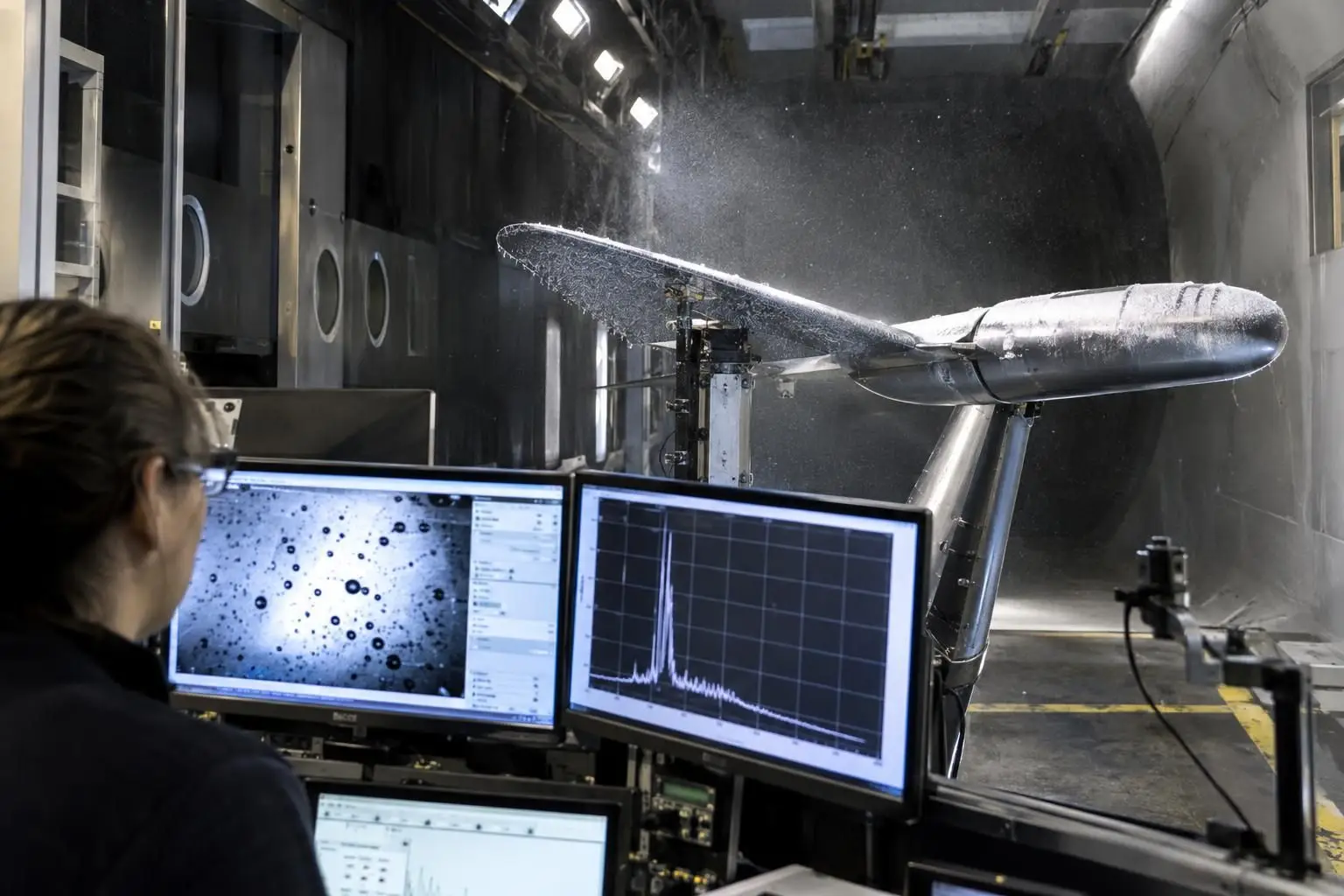
At the Icing Research Tunnel at Glenn Research Center in Cleveland, researchers tested new probes to calibrate the size of droplets in clouds produced by the tunnel. The probes can detect drops larger than 45 microns and analyze their sizes in real time.
NASA will compare those readings with droplet-size images processed after the tests, a more labor-intensive method. The results will also be combined with measurements from a different probe for droplets smaller than 45 microns, allowing the team to determine the full droplet-size spectrum.
Analysis is still underway
The test campaign marks a milestone for NASA’s Subsonic Flight Demonstrator project. Detailed analysis of the collected data continues, and the project team plans to share results with the broader aerospace community once that work is complete.
What the icing measurements mean
The numbers describe different things. The 45-micron split is how the two probes divide their measurements; it is not a statement that every droplet above that size is unusually large. NASA separately describes typical icing-cloud droplets as 2 to 100 microns and rarer large droplets reaching 2,000 microns. This distinction helps explain why researchers combine the probes rather than relying on one reading.
What this means for aviation safety
The immediate audience is engineers assessing how their tools represent icing conditions. NASA’s October 5 report says analysis continues; it does not announce a fleetwide equipment change or a completed safety improvement. Its photo captions date the tunnel testing to June 8–11, 2026, distinguishing the experiment from the announcement.
The next stated step is sharing results with the aerospace community after analysis. This is research progress, not a forecast of icing on a particular flight.
For another distinct NASA test program, read our X-59 flight-testing update. That program studies supersonic flight rather than aircraft icing.
Source: NASA.