




UK air accident investigators have concluded that a pitch increase during a bounced landing, compounded by the effect of the ground spoilers extending, caused a DHL freighter’s tail strike at London Heathrow on October 12, 2025. The Air Accidents Investigation Branch (AAIB) published its final report on November 12, 2026. Both crew members were uninjured, but the Airbus A300 was later retired after a structural assessment.
What happened at Heathrow
The freighter, registered D-AEAG, was flying from Leipzig/Halle Airport to Heathrow. The IATA 2025 safety report identifies the operator as European Air Transport Leipzig. The AAIB found the aircraft bounced on its first touchdown on runway 09L. After it touched down again, the commander pulled back on the controls to ease the nosewheel onto the runway. With the spoilers still extending, the nose rose far enough for the tail to strike the runway.
The commander initiated a go-around because he believed the bounce might have been severe. The crew made a second approach and landed on runway 09R. The first landing attempt left damage to the lower tail and internal structure. The aircraft stayed at Heathrow for several months and was assessed as beyond economical repair.
Why the AAIB separated the tail strike from the go-around
The commander had already selected reverse idle before deciding to go around. The AAIB said this likely happened as a habitual response during touchdown. The manufacturer and operator required crews to complete a full-stop landing once reverse idle was selected. The investigators found that reverse selection delayed the increase in engine thrust during the go-around and was unlikely to have contributed to the tail strike itself.
Airbus assessed the bounce as light, while the commander believed it might have been high. The report says crews have no predefined thresholds to distinguish the two and must judge the bounce in real time. About four seconds elapsed from the first main gear contact to the commander advancing the thrust levers. The investigators also found that turbulence and gusts were unlikely to have been factors.
Read the AAIB’s final report (PDF) or its report summary. Big Jet TV’s footage from October 12, 2025 shows the landing sequence from outside the aircraft.
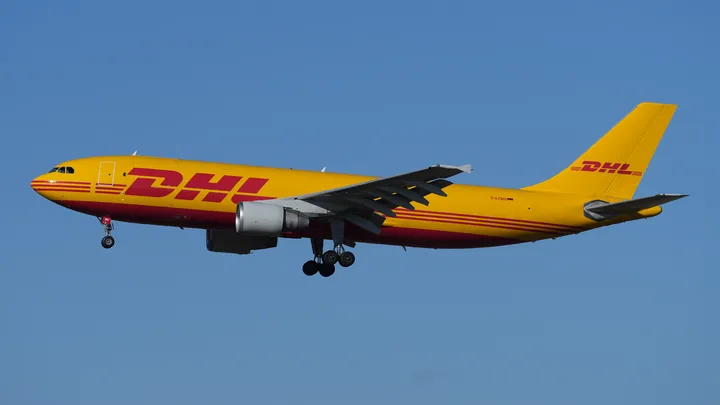
Archive: a different DHL Airbus A300 freighter, D-AZMN, approaching Leipzig/Halle in March 2026. Photo by MarcelX42 via Wikimedia Commons, CC BY-SA 4.0. Full frame resized and converted to WebP. The resized image retains the licence.