




More than 6,200 flights within, into or out of the United States were canceled on Saturday, November 14, the day after the FAA’s nationwide ground stop, according to FlightAware figures reported by CNN. At least 760 flights were already canceled for Sunday. Officials now say the outage began during contractor work on telecommunications lines at a remote FAA site, but the exact fault is still under investigation.
- Update, Tuesday, November 17: senators ask FAA to pause router upgrades
- Update, Monday, November 16: schedules near normal, focus turns to the equipment
- Update, November 15: what officials now say caused the outage
- Sunday, November 15: recovery
- What happened on Friday
- Friday night’s first explanation
- Saturday cancellations by airline
- What passengers can do
- Push for emergency funding
Update, Tuesday, November 17: senators ask FAA to pause router upgrades
Thirteen Democratic senators on the Senate Commerce Committee, led by Maria Cantwell, wrote to the FAA on Tuesday asking it to pause the router replacement programme until the investigation into the ground stop is finished, Al Jazeera reported. Citing L3Harris figures, the senators said the copper-to-fibre switch involves converting 3,648 routers to Juniper devices; about 400 have been installed and 69 are in operation. They want the FAA to hold off on the remaining 3,000-plus.
The FBI said on Tuesday it is working with the Department of Transportation, the FAA and L3Harris on the investigation but has not taken possession of any equipment. Transportation Secretary Sean Duffy said on Sunday the FAA will have to rethink when it does this kind of work: maintenance at major facilities is normally done overnight, but work at remote sites has been allowed during the day because it was considered low risk, Newsweek reported.
The White House has asked Congress for $50 billion to finish overhauling the FAA’s equipment. Democratic lawmakers say the administration has used only a fraction of the $12.5 billion approved last year. For travellers, flights are running largely normally again; the cause of the outage has not been officially confirmed.
Update, Monday, November 16: schedules near normal, focus turns to the equipment
Airline operations were mostly back to normal or close to it on Monday, CBS News reported, although CNBC reported hundreds of further cancellations. FlightAware counted about 6,700 US cancellations on Saturday and about 1,570 on Sunday by mid-morning. The FAA said operators cancelled about 12,462 flights on Friday, including 9,082 by major airlines.
New details have emerged about the hardware. The Wall Street Journal reported that the router at the centre of the outage was a new Juniper Networks device that L3Harris had installed at an FAA radio site in El Dorado, Arkansas. Hewlett Packard Enterprise, which owns Juniper, said the devices appeared to work as intended and “did not fail”, Yahoo News reported. On Sunday, Duffy said a second router, in Amarillo, Texas, which had been replaced about three weeks earlier, had also flooded the network. Both devices are being examined at an L3Harris lab in Florida, with the FBI involved. Officials believe a feature that broadcast data more widely than needed caused the overload, and Duffy said it has been switched off on all 69 routers of that type. Reports on the exact equipment involved still differ, and no final cause has been announced.
Duffy said officials are examining whether “incompetence” at L3Harris played a part, but that he cannot simply cancel the company’s contract because it owns the network, The Hill reported. L3Harris says it is supporting the FAA’s investigation. Its shares fell in early trading on Monday, Bloomberg reported. Congressional staff were due to be briefed on Monday on the administration’s funding request for air traffic control, which it raised to $30 billion late on Friday; Duffy has called for $50 billion.
Update, November 15: what officials now say caused the outage
At a Saturday briefing, Transportation Secretary Sean Duffy said the problem started while L3Harris Technologies, which runs the FAA’s telecommunications network, was doing routine work at a remote FAA site, switching lines from copper to fiber at about 3 p.m. ET on Friday. He said a router involved in that work flooded other routers in the network with connection attempts, Yahoo News reported. Officials have not named the site.
Duffy said investigators had not yet determined whether the contractor made an error or the router was faulty. FAA Administrator Bryan Bedford said the review will establish whether the router was installed or configured incorrectly, or was defective. The FAA said it had disabled the function involved on about 60 routers of the same type nationwide while it tests the equipment with L3Harris (Duffy later put the number at 69). L3Harris said it is supporting the FAA’s investigation.
Bedford said about 12,000 flights could not be completed on Friday, roughly 9,000 commercial and 3,000 private or general aviation flights. He said officials had found no evidence of anything nefarious or of any role for artificial intelligence, and that airlines expected schedules to be back to normal by the end of Sunday, November 15.
Nick Daniels, president of the National Air Traffic Controllers Association, said communications with some aircraft were disrupted and controllers moved flights to working frequencies. He said controllers ensured the safety of every aircraft.
Sunday, November 15: recovery
Cancellations fell sharply on Sunday. FlightAware data reported by RTÉ showed about 9,200 US flights cancelled on Friday and more than 6,400 on Saturday, while 875 Sunday flights had been cancelled by Saturday night. FAA Administrator Bryan Bedford said he expected airline operations to largely return to normal by late Sunday.
L3Harris said it is supporting the FAA’s investigation and that it has completed more than 70% of the switch from copper wiring to a fiber-optic system, CNBC reported. Duffy said investigators are working to establish whether the outage was caused by installer error or a faulty router. No final cause has been announced.
What happened on Friday
The FAA halted departures from all US airports at 3:54 p.m. ET (20:54 UTC) on Friday, November 13, after communication problems hit its Air Route Traffic Control Centers, the 22 facilities that handle aircraft flying between airports. The agency said the issues affected multiple centers, and the nationwide order followed an earlier halt at Chicago O’Hare and Midway.
Transportation Secretary Sean Duffy said instability in radar and communications at the centers began shortly after 3:30 p.m. ET, when more than 3,500 aircraft were airborne. He said controllers never lost all radar or communications and that no flights were put at risk. The FAA lifted the ground stop at about 8:15 p.m. ET after testing its systems, more than four hours after it began.
It was the first nationwide US ground stop since January 2023, when a damaged database file took down the FAA’s NOTAM system. The Associated Press described Friday’s stoppage as the longest since the September 11, 2001, attacks.
Friday night’s first explanation
At a Friday night briefing, Duffy and Homeland Security Secretary Markwayne Mullin said older switches and routers became overloaded with data after new software patches were installed across the system, causing intermittent gaps in communications and radar feeds. Both said investigators were still working through the details. Mullin said there was no evidence of a cyberattack.
CBS News and The Wall Street Journal reported that the problem involved the private telecommunications network that links US air traffic control facilities, which is operated by L3Harris Technologies. The FAA has not publicly confirmed that account.
Duffy rejected suggestions that the FAA’s new AI-supported traffic management tool, SMART, played a role. The FAA expanded the tool to all 22 en-route centers on Tuesday, November 10. Duffy said it is not connected to the core radar and flight-tracking systems, and its developer, Air Space Intelligence, said its technology did not cause the stoppage.
Saturday cancellations by airline
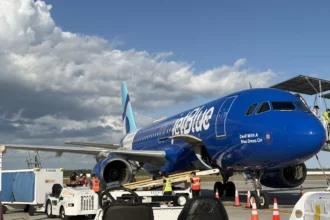
By mid-morning ET on Saturday, Delta had canceled about 20% of its scheduled flights for the day, United about 17% and American about 15%, CNN reported, citing FlightAware. Earlier on Saturday morning, FlightAware data showed JetBlue had canceled about 40% of its schedule, the highest share among major US airlines. Southwest warned of continued delays and cancellations while it restores its schedule.
Duffy said on Saturday that operations were slowly returning to normal and that the FAA was coordinating with airlines on the recovery. Airlines have warned that aircraft and crews left out of position on Friday will keep causing disruption through the weekend.
What passengers can do
- Check your flight in your airline’s app before leaving for the airport.
- Major airlines have issued travel waivers letting affected passengers change flights without a change fee. Bedford said passengers would be rebooked or offered a full refund and urged them to contact their airline directly. Check your airline’s travel alert page for the eligible dates.
- If your flight is canceled, or a domestic flight is delayed by three hours or more, and you decide not to travel, US Department of Transportation rules entitle you to a full refund of the unused ticket, whatever the cause. If you accept a rebooked flight or a travel credit instead, the refund no longer applies.
- Because the disruption came from air traffic control rather than an airline problem, meal and hotel help depends on each airline’s own policy. Ask your airline what it is offering.
Push for emergency funding
Duffy used Friday’s briefing to ask Congress for $50 billion in emergency funding to replace air traffic control hardware, software, telecommunications equipment and facilities. Earlier on Friday, before the outage, the administration had asked lawmakers for $30.1 billion, including $10.1 billion for air traffic control modernization and $18 billion for airport projects. Congress approved $12.5 billion for modernization last year, and the FAA began replacing decades-old controller information displays earlier this month.
The FAA has not announced a final cause, and the investigation is continuing.
Traveller guides: Flight delayed or cancelled? Your rights · Refunds: cash or voucher? · Missed connection? · Lost or delayed bag?
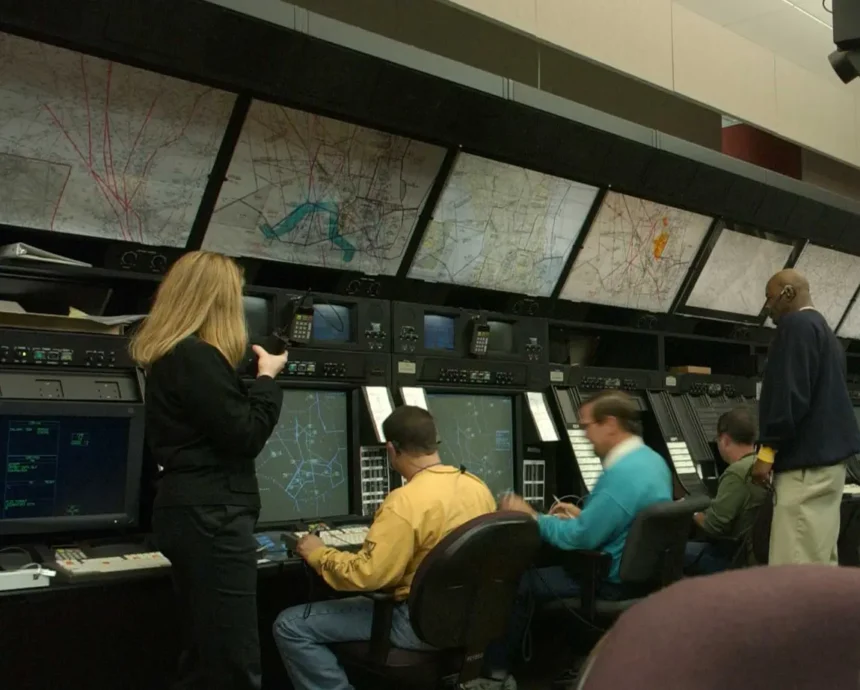
Archive photo of controllers at the FAA’s Washington Air Route Traffic Control Center; not taken during the November 13 outage. Photo by the Federal Aviation Administration via Wikimedia Commons, U.S. public domain. Commons crop resized and compressed to WebP by Flyzeu. Photo date unknown.