




Delta personal item size depends on under-seat fit, not a universal measurement on the airline’s policy page. Its 22 × 14 × 9-inch box is the separate carry-on limit.
Delta personal item size versus carry-on size
Use the two categories separately when planning your luggage:
| Category | Storage | Published guidance |
|---|---|---|
| Personal item | Under the seat | Fit-based; no numeric size box in the personal-item section |
| Carry-on | Approved cabin storage | 22 × 14 × 9 inches (56 × 35 × 23 cm); 45 linear inches maximum; wheels and handles included |
Source: Delta’s carry-on policy. The overhead-bag measurement does not establish under-seat fit.
Can a backpack count as a personal item?
A small backpack is a listed example. For packing purposes, judge the bag when it is ready to travel—not empty on a shop display. A soft backpack can become much deeper once you add a laptop sleeve, jacket and filled side pockets.
A quoted capacity such as “20 litres” or “35 litres” is not an airline approval. Two bags with the same volume can have different proportions. Nor does a label saying “personal item” establish that the packed bag suits your particular aircraft.
Suitcase, backpack and purse: plan the bag count
Delta’s baggage overview lists one free carry-on and one personal item. A useful packing plan is a cabin suitcase plus an under-seat backpack, with a small purse packed inside the backpack if you need both.
Illustrative example: pack your ordinary daily bag first, then put the purse inside and close every compartment. If that makes the backpack bulge substantially, rethink the contents before departure. This is a planning example, not a hands-on test or a promise that a gate agent will approve it.
Some special items have separate rules. Do not treat a general two-bag example as a restriction on qualifying medical or assistive equipment; our Delta assistance guide provides a starting point for arranging help.
A practical check before leaving home
- Pack completely. Include the charger, outer layer and anything normally carried in an exterior pocket.
- Measure the actual shape. Write down height, width and packed depth, rather than relying only on a product name or capacity.
- Plan access. Put documents and items you expect to use together so you do not need to unpack clothing to reach them.
- Check every flight operator. A ticket sold by Delta can include another airline. Confirm that operator’s cabin-bag instructions too.
What if the overhead bag is checked at the gate?
Delta’s FAQ describes planeside handling on Delta Connection aircraft with 50 seats or fewer. Follow your flight’s instructions and bag tag; do not generalize that process to every regional aircraft.
Before handing over a bag, follow the FAA’s battery guidance: spare lithium batteries must remain in the cabin, including when a bag is checked at the gate. Keep their terminals protected against short circuits. For power banks, consult the FAA’s lithium-battery baggage guidance; those also need to stay with you rather than in the checked bag.
Keep a short “remove before checking” list with your packing notes. This is more useful than discovering at the aircraft door that an essential item is buried in the suitcase.
Official guidance checked October 12, 2026. Delta and the operating airline determine acceptance on the actual flight. This guide is not a bag endorsement, measurement of aircraft storage, or guarantee of fit.
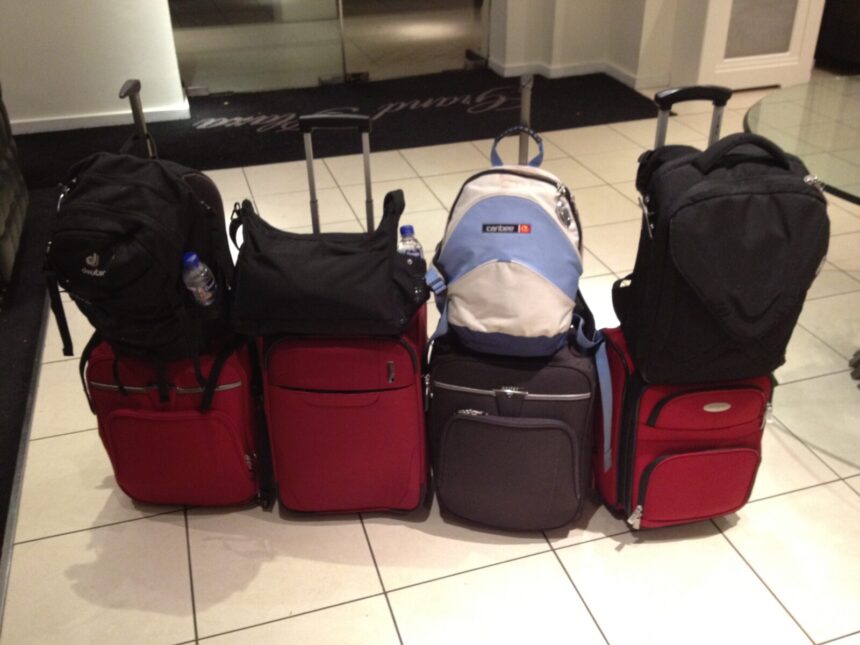
Travelers’ luggage (archive, 2011), not a bag-fit test. Kathryn Greenhill · CC BY-SA 2.0; resized.