




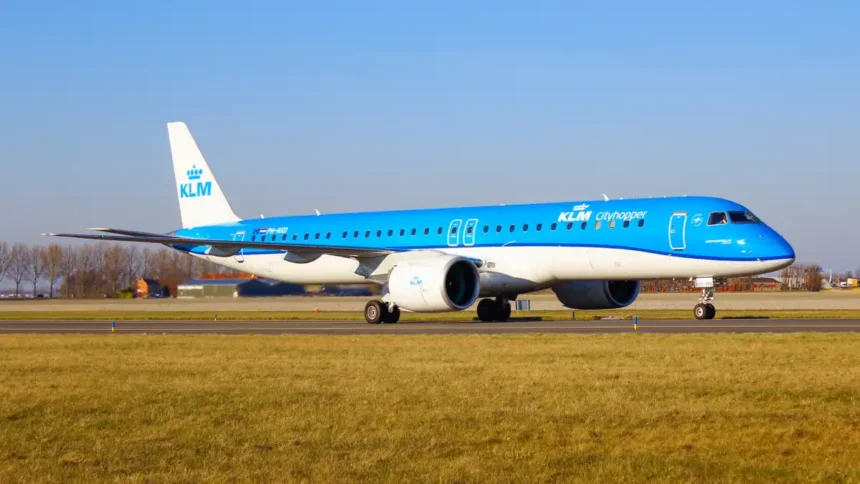
The US Federal Aviation Administration is seeking comments until November 27 on proposed certification conditions for Embraer’s Enhanced Takeoff System, or E2TS. Its October 27 notice concerns the ERJ 190-400, marketed as the E195-E2. It is a proposal, rather than an announcement that the system has been approved for airline service.
What the crew would still control
The FAA describes automatic pitch control, including rotation and initial climb, and bank-angle control. Pilots would still maintain the runway centreline through manual directional control during the ground run. The proposal therefore describes a specific automated takeoff function, not a pilotless aircraft.
What the proposed tests address
The FAA’s proposed conditions replace assumptions about variation in human rotation technique with limits that account for system tolerances and sensor accuracy. With one engine inoperative, the resulting takeoff distance must remain within the corresponding flight-manual distance. With all engines operating, the proposed limit permits no more than a 1% increase. The function must not produce unsafe flight characteristics.
Brazil’s earlier certification step
Brazil’s ANAC adopted a related special condition through Resolution 812, dated September 21 and published September 23. That measure adds requirements for automated takeoff rotation-speed variability to the certification basis for the E2TS design change. It should not be confused with a declaration that the complete modification has received certification.
ANAC’s text also addresses one-engine-inoperative takeoff distance, expected rotation-speed deviations and out-of-trim conditions. Its all-engines-operating provision requires no marked increase in the corresponding flight-manual takeoff distance and no unsafe flight characteristics; the wording differs from the FAA’s proposed numerical 1% limit.
The two documents describe separate national regulatory steps. Neither establishes a flight-by-flight airline rollout date. The US consultation remains open under docket FAA-2026-10627. Transport Canada’s model table separately confirms the ERJ 190-400/E195-E2 naming.
Sources checked November 2: FAA proposed special conditions, published October 27; ANAC Resolution 812; ANAC’s English and Portuguese special-condition text; Transport Canada’s E-Jets model table.